
 EN
EN
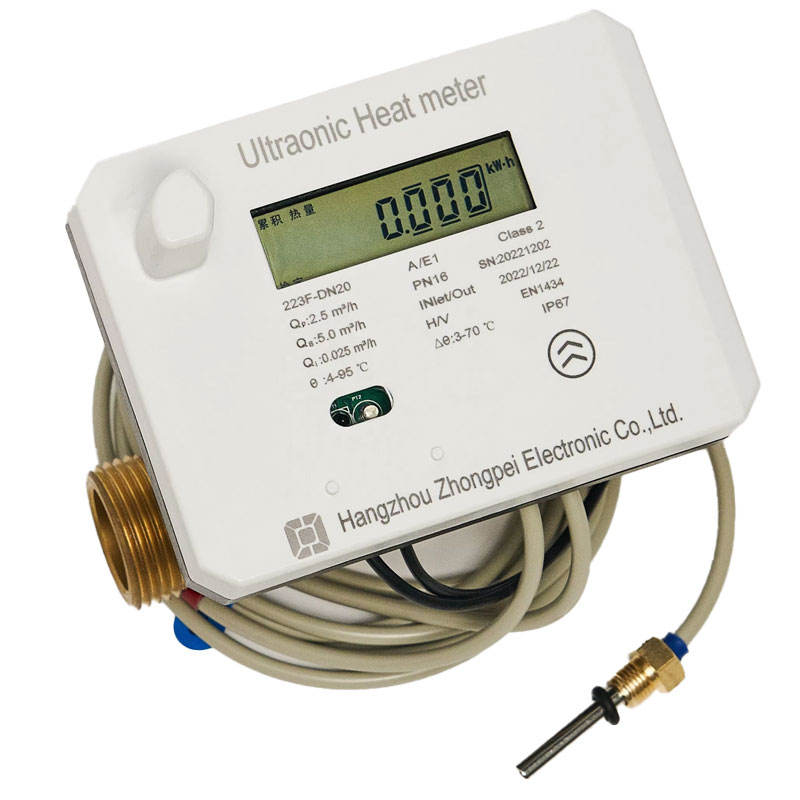
Core Components and Their Impact on Heat Meter Accuracy
Role of Flow Sensors, Temperature Sensors, and Calculators in Thermal Energy Measurement
Heat meters today rely on three main parts working together. Flow sensors track how much water is moving through the system, while temperature sensors work in pairs to spot differences between incoming and outgoing water temperatures. The calculator component then does some serious math using thermodynamic formulas to figure out exactly how much thermal energy has been used. For homes, most Class 2 meters stay within about plus or minus 5% accuracy as long as their temperature sensors follow those IEC 60751 standards for platinum resistance thermometers, which means they need to be pretty accurate themselves around 0 to 100 degrees Celsius. But problems start showing up when there's a mismatch between super precise calculators that can measure down to 0.01 kWh and older flow sensors that aren't quite as good, often missing by about 2%. These kinds of mixups actually happen a lot in practice, and field tests have found that over time, these small errors can pile up until we're looking at total inaccuracies as high as 5.7% across entire systems.
How Calculator Resolution and Algorithms Influence Final Heat Readings
The latest generation of calculators incorporates smart algorithms that adjust for changes in fluid density, which helps cut down on errors when dealing with glycol mixtures by around half a percent either way. They also handle those tricky momentary flow fluctuations much better than older models. The jump from 16-bit to 24-bit processors makes a real difference too. Tests show these newer chips reduce rounding problems by about forty percent according to the EN 1434 standards. Even though most devices have similar hardware specs, different companies keep their calculation formulas secret, so results can vary quite a bit between brands. An interesting study back in 2022 found that when labs tested the same equipment under exactly the same heat conditions, outputs differed anywhere from 1.8% to 3.2%. That kind of variation matters in precision applications where small differences add up over time.
Case Study: Component Mismatch Causing 5% Deviation in Class 2 Heat Meter
A Nordic district heating project illustrated how integration issues undermine performance despite component-level certifications:
- Flow sensor: ±2.5% uncertainty (DN25 ultrasonic type)
- Temperature sensors: ±0.4°C matched pair
- Calculator: 0.01 kWh resolution with EN 1434-compliant algorithms
System testing revealed a 5.2% overregistration due to time synchronization delays between flow and temperature data inputs. This underscores the importance of system calibration, which reduces overall uncertainty threefold compared to evaluating components individually.
Calibration Practices and Long-Term Measurement Reliability
System-level vs. separate calibration: Differences in accuracy outcomes
When we test the whole heat meter setup in actual operating conditions what we call system level calibration it cuts down on integration problems by around 40% versus when components are calibrated individually according to those 2023 Calibration Guidelines. This approach actually takes into account how different parts interact dynamically during operation, such as when temperature sensors react slowly and throw off flow measurements. Sure, calibrating each part separately goes quicker, but this method tends to overlook bigger picture issues that come up over time because of things like mechanical wear and tear or when different pieces of software don't play nice together in the same system.
Calibration drift over time and its effect on heat meter performance
Even Class 1 meters experience approximately 0.8% annual accuracy degradation due to sensor fatigue and fluid contamination (Ponemon 2022). This drift is asymmetric; in glycol-based systems, temperature probes lose sensitivity 23% faster than flow sensors. As a result, manufacturers increasingly recommend condition-based recalibration using predictive algorithms instead of fixed intervals.
Field evidence: System-calibrated meters reduce uncertainty by 15%
A 12-month study of 450 district heating installations found that system-calibrated meters maintained ±2.1% accuracy, outperforming separately calibrated units at ±3.7%. The improvement comes from unified error compensation that simultaneously adjusts for flow turbulence and transient temperature changes.
Debating the need for periodic recalibration across accuracy classes
Class 2 and 3 meters typically exhibit 0.5% annual drift—often within acceptable regulatory limits—while Class 1 devices require recalibration every 18–24 months to preserve their sub-1% accuracy claim. Emerging self-diagnostic systems with embedded reference sensors may extend reliable operation to five years for stable installations by 2025.
Global Accuracy Standards and Classification Systems
Key Standards: EN 1434, OIML R75, ASTM E3137, and CSA 900.1-13 Compared
Heat meter accuracy hinges on compliance with international standards, each tailored to regional needs:
- EN 1434 (Europe): Requires ±3% deviation tolerance for temperature sensors and uses 30:70 glycol-water mixtures in testing
- OIML R75 (Global): Specifies ±2% uncertainty for Class 1 meters at ∆T=10K, tested with pure water
- ASTM E3137 (North America): Sets 0.5% volumetric flow accuracy thresholds
- CSA 900.1-13 (Canada): Includes frost protection validation for sub-zero operations
These differing test conditions establish distinct calibration benchmarks, complicating cross-border compatibility.
Understanding Class 1, Class 2, and Class 3 Meters and Their Practical Implications
Accuracy classes define operational performance:
- Class 1: ±2% error (used in district heating networks)
- Class 2: ±4% tolerance (common in commercial HVAC)
- Class 3: ±6% variance (suitable for basic residential monitoring)
However, real-world conditions affect performance. A 2023 International Energy Agency study found Class 2 meters averaged 1.9% overestimation in low-flow applications (<0.6 m³/h), exceeding their classification limits.
Challenges in Multinational Projects Due to Divergent Regulatory Requirements
About 45% of HVAC installers run into trouble with regulations when setting up systems in different countries. Take one real world case study for instance. A Canadian company had this EN 1434 certified meter that just wouldn't pass the OIML R75 test. Why? Because there was this difference in the minimum temperature differential requirements between standards (some wanted 3K others required 5K). This caused major headaches for a geothermal project worth around $2.1 million dollars, which ended up getting delayed for eleven whole weeks. This kind of situation highlights the bigger picture problem we're facing with trying to get all these international standards to line up properly.
Sensor Placement, Alignment, and Environmental Influences
Proper installation geometry is critical, with positioning errors contributing to 10–25% of field measurement discrepancies according to fluid dynamics research.
Common Sensor Misalignment Issues in Hydronic Heating Systems
Axial misalignments exceeding 3° in temperature sensor pairs generate thermal profile distortions equivalent to 0.4 K errors under EN 1434 protocols. In glycol-based systems, angular misalignment reduces flow symmetry by 18%, as demonstrated in recent laboratory simulations, reinforcing the value of laser-guided alignment tools during setup.
Thermal Contact Gaps and Their Impact on Temperature Differential Accuracy
A 0.1 mm air gap between pipe and clamp-on sensors introduces 1.2–1.8% uncertainty in ∆T readings. Field data show epoxy-filled thermal interfaces improve conductance by 37% over mechanical fastening alone, significantly enhancing measurement fidelity.
Flow Sensor Positioning and Its Effect on Velocity Profile and Accuracy
Installing flow sensors within 5 pipe diameters of elbows or pumps distorts velocity profiles, causing 7–12% volumetric errors in ultrasonic meters. A 2023 analysis of 120 HVAC systems confirmed that following 10D upstream/5D downstream straight-pipe rules reduces asymmetry to less than 2%, meeting ASTM E3137 requirements.
Case Study: 12% Overestimation Due to Improper Sensor Placement in HVAC Loop
A hospital's heat meter consistently overreported consumption until technicians identified turbulent flow at a vortex-shedding sensor located too close to a pump. Relocating the device 8 pipe diameters downstream eliminated the 12% deviation, proving how adherence to proper placement protocols directly affects billing accuracy.
Fluid Properties and Installation Conditions Affecting Heat Meter Performance
How Fluid Density and Specific Heat Variations Influence Measurement Precision
The formula for calculating thermal energy looks like this: Q equals rho multiplied by c_p multiplied by delta T. This means that when we're dealing with fluids, their density (rho) and specific heat capacity (c_p) become really important factors to consider. When it comes to district heating systems, those seasonal temperature changes actually create some pretty significant problems. Water density tends to fluctuate between 4 and 7 percent throughout different seasons, which introduces around plus or minus 2.5 percent uncertainty into calculations. Things get even trickier with glycol-water mixtures. These have about 18 percent less specific heat than regular water, so without proper adjustments to the software compensation settings during each season, operators might end up with readings that are off by as much as 12 percent. That kind of error margin can cause all sorts of headaches for maintenance teams trying to keep systems running efficiently.
Accuracy Challenges With Glycol-Water Mixtures in District Heating Systems
When antifreeze gets mixed into systems, it messes with viscosity in ways that throw off flow sensors completely. The numbers get interesting around 40% glycol concentration where the switch from smooth to turbulent flow happens about a quarter sooner compared to plain water. This causes mechanical meters to miss the mark by roughly 9%, according to research published by HVAC Standards Consortium back in 2024. While newer ultrasonic meters try to compensate through something called dynamic Reynolds number calculations, these devices aren't immune to issues either. They still need regular checkups once a year whenever the mix of antifreeze in the system changes, which happens more often than most people realize in real world applications.
Impact of Transient Conditions and Low Temperature Gradients on Uncertainty
During startup, thermal inertia creates scenarios with ∆T < 3°C, where 72% of mechanical meters exceed their stated accuracy class. Electromagnetic meters perform better, maintaining ±3% error even at 1°C gradients (EnergoMetrics Report 2023). However, flow changes exceeding 10%/minute induce 5–8% instantaneous errors across all types due to delayed synchronization between sensors.
Best Practices for Installation: Minimizing Turbulence and Ensuring Proper Pipe Coverage
| Installation Factor | Optimal Condition | Accuracy Impact |
|---|---|---|
| Upstream Pipe Length | ≥10× pipe diameter | Reduces swirl errors by 80% |
| Sensor Orientation | Horizontal ±5° | Prevents air bubble accumulation (12% error risk) |
| Insulation Coverage | Full pipe wrapping | Maintains ∆T measurement within 0.2°C of actual |
A 2024 field trial showed strict adherence to EN 1434 guidelines improves long-term accuracy by 18% versus ad-hoc installations. Ultrasonic meter users should prioritize symmetrical pipe sections—flow asymmetry degrades transit-time measurements by 9–14%, even with advanced signal processing.
Frequently Asked Questions (FAQs)
What are the main components of a heat meter?
A heat meter typically consists of flow sensors, temperature sensors, and calculators. These components work together to measure and calculate thermal energy usage in a heating system.
Why is system-level calibration preferred over separate calibration?
System-level calibration accounts for integration issues and dynamic interactions between different components during operation, reducing inaccuracies by approximately 40% compared to calibrating components individually.
What are the challenges with using glycol-water mixtures in heating systems?
Glycol-water mixtures can affect the viscosity and specific heat capacity, leading to errors in flow sensor measurements and requiring periodic adjustments and checkups to maintain accuracy.
How do international standards influence heat meter accuracy?
Heat meter accuracy depends on compliance with international standards such as EN 1434, OIML R75, ASTM E3137, and CSA 900.1-13, each of which has specific requirements that affect calibration and performance.
Table of Contents
- Core Components and Their Impact on Heat Meter Accuracy
- Calibration Practices and Long-Term Measurement Reliability
- Global Accuracy Standards and Classification Systems
- Sensor Placement, Alignment, and Environmental Influences
-
Fluid Properties and Installation Conditions Affecting Heat Meter Performance
- How Fluid Density and Specific Heat Variations Influence Measurement Precision
- Accuracy Challenges With Glycol-Water Mixtures in District Heating Systems
- Impact of Transient Conditions and Low Temperature Gradients on Uncertainty
- Best Practices for Installation: Minimizing Turbulence and Ensuring Proper Pipe Coverage
- Frequently Asked Questions (FAQs)