
 EN
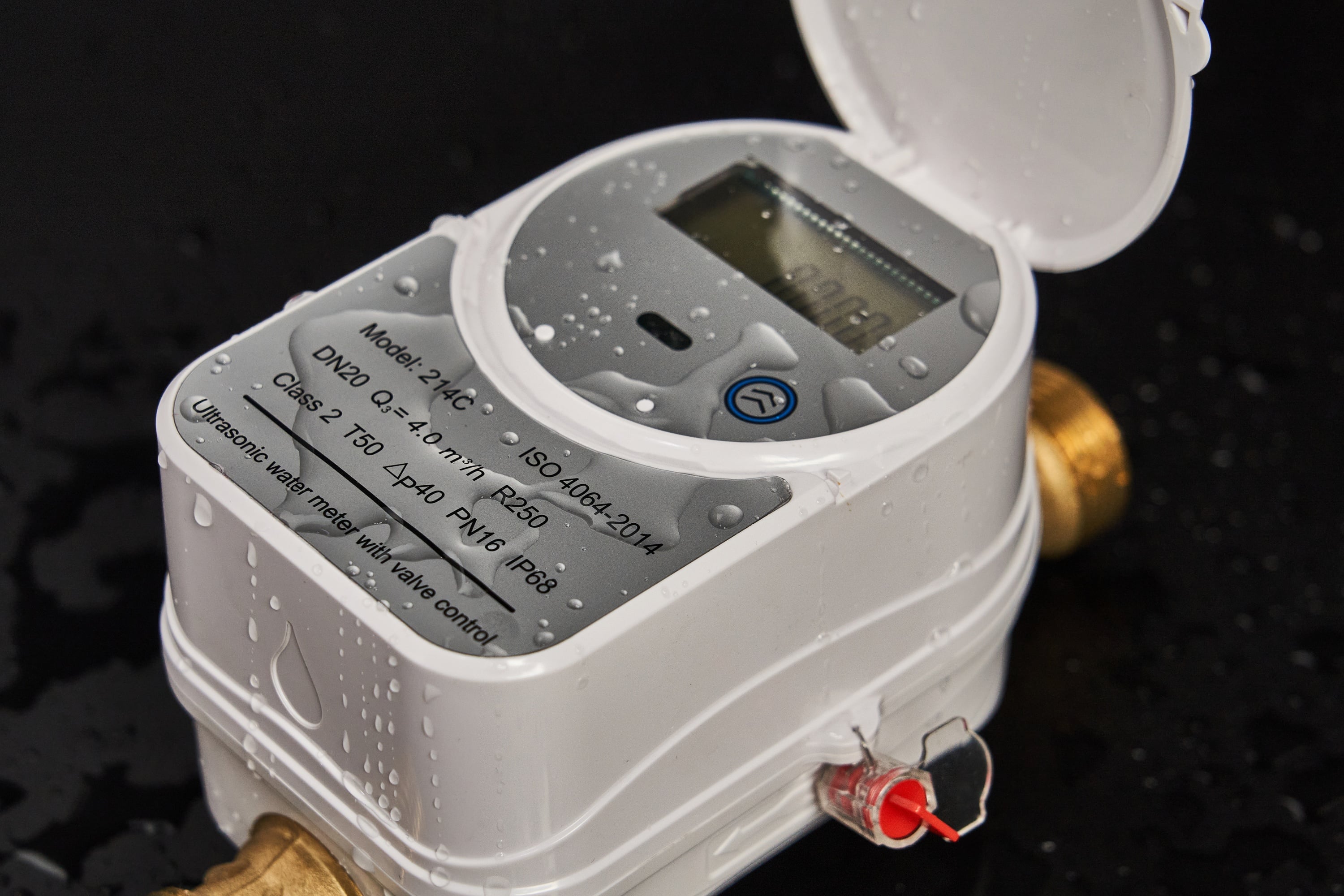
Precision Measurement Across All Flow Ranges
An ultrasonic water meter delivers stable, high-accuracy measurement across the full residential flow range—from a trickle of 0.01 L/min to peak household demand. Unlike mechanical meters, whose accuracy degrades at low flow due to fixed full-scale error, ultrasonic meters maintain reading-based precision regardless of flow rate.
±1% Accuracy Down to 0.01 L/min: Why Low-Flow Precision Matters for Residential Billing and Conservation
Most residential water use occurs at low flow: toilet refills, dripping faucets, or cycling irrigation valves. If a meter cannot reliably detect these flows, billing becomes inaccurate—leading to under-recovery for utilities or overcharging for residents. Traditional mechanical meters specify accuracy as ±1% of full scale (e.g., ±1 m³/h on a 100 m³/h meter). At partial load, that fixed error balloons into large relative inaccuracies. In contrast, ultrasonic meters deliver ±1% of reading, ensuring consistent fidelity across the operating range.
| Accuracy basis | Error at 100 m³/h | Error at 10 m³/h | Relative error at 10 m³/h |
|---|---|---|---|
| ±1% full scale | ±1 m³/h | ±1 m³/h | ±10% |
| ±1% of reading | ±1 m³/h | ±0.1 m³/h | ±1% |
This reading-based accuracy down to 0.01 L/min ensures every liter is measured fairly. It supports equitable billing, reduces non-revenue water, and gives households real-time, trustworthy feedback—proven to drive conservation behavior. By eliminating drift and under-registration at low flow, ultrasonic meters help utilities recover lost revenue while empowering residents with transparency.
Detecting Flows as Low as 0.5 L/h: Enabling Early, Automated Leak Identification
Ultrasonic meters detect sustained flows as low as 0.5 L/h—well below the starting threshold of most mechanical devices. This sensitivity enables automated, continuous leak detection without manual inspection.
| Leak rate | Daily volume | Monthly volume | Annual volume |
|---|---|---|---|
| 0.5 L/h | 12 L | 360 L | 4.4 m³ |
| 2.0 L/h | 48 L | 1,440 L | 17.5 m³ |
A 0.5 L/h leak may seem minor, but it often signals early-stage failures: a deteriorating toilet flapper, micro-fracture in a service line, or degraded irrigation valve seat. Because ultrasonic meters log flow continuously and digitally, they can flag sustained low-flow events, timestamp duration, and trigger alerts via central platforms. Field experience shows such leaks are typically identified within 24–48 hours—preventing months of undetected loss. With no moving parts to foul or jam, this detection capability remains stable across years and varying water conditions, shifting maintenance from reactive to predictive.
Extended Lifespan and Zero-Maintenance Operation
12–15 Year Service Life with <0.5% Drift: Engineering Long-Term Stability for Residential Infrastructure
Ultrasonic water meters rely on solid-state transducers and time-of-flight acoustic measurement—not gears, pistons, or magnetic couplings. This eliminates mechanical wear points that degrade under daily residential flow cycles. Accelerated life-cycle testing and multi-year utility pilots confirm less than 0.5% total drift after 12 years of continuous operation. The time-of-flight principle measures the differential transit time of ultrasonic signals traveling upstream versus downstream; because it depends only on acoustic velocity—not physical movement—it remains unaffected by mineral buildup or fine sediment. Over a 15-year service life, this stability prevents progressive under-registration—the leading cause of non-revenue water and customer disputes. Utilities defer capital replacement, reduce field recalibration labor, and cut truck rolls. Homeowners benefit from consistent bills and fewer service interruptions. When lifecycle costs—including maintenance, recalibration, and premature replacement—are factored in, ultrasonic meters often deliver lower total cost of ownership than mechanical alternatives.
No Moving Parts = No Wear: Reliable Performance in Hard, Chlorinated, or Sediment-Prone Water Supplies
Mechanical meters suffer in challenging water conditions: hard water causes scaling on impellers; chlorine degrades elastomeric seals and plastic gears; sediment jams chambers and erodes bearings. Ultrasonic meters have no components in the flow stream—only smooth, non-fouling transducer faces mounted externally or flush-mounted in the pipe wall. There are no rotors to clog, no seals to crack or swell, and no lubrication points to fail. Utility field data from regions with aggressive water chemistries—including high hardness, elevated chlorine residuals, and seasonal sediment loads—show stable registration across multiple seasons without intervention. Calibration drift remains below 0.5% over the full service life. This enables true zero-maintenance operation: no strainer cleaning, no bearing replacement, no impeller swaps. For residents, it means uninterrupted, accurate billing. For utilities, it means predictable asset performance—even in the most demanding supply environments.
Proactive Water Loss Prevention and Conservation Impact
Ultrasonic water meters transform residential water management from reactive repair to proactive loss prevention. Their continuous, high-resolution flow sampling detects subtle, persistent anomalies—leaking toilet flappers, pinhole pipe fractures, or slow-drip irrigation lines—that mechanical meters routinely miss. This early identification directly reduces non-revenue water (NRW), the treated water lost before reaching the customer.
The conservation impact extends beyond volume saved. Early leak intervention reduces extraction, treatment, and pumping energy—lowering operational carbon emissions. It also safeguards water quality by minimizing opportunities for contaminants to enter through pressure drops or compromised pipe integrity. For utilities and property managers, the meter functions as a distributed, real-time conservation sensor—converting nuanced flow deviations into actionable maintenance alerts before they escalate into costly failures or resource waste.
Seamless Integration with Smart Water Management Systems
Non-Intrusive Ultrasonic Transduction: Preserving Pipe Integrity, Hygiene, and Retrofit Flexibility
Ultrasonic meters use solid-state piezoelectric transducers to transmit acoustic signals through the pipe wall or spool body—without contacting the water or obstructing flow. This non-intrusive design maintains full-bore flow path integrity, eliminates pressure loss, and avoids turbulence-inducing mechanical elements. With no impellers, paddles, or internal chambers, there are no failure-prone moving parts—and no biofilm traps that compromise hygiene or long-term signal stability. Compact spool dimensions match standard residential pipe connections, enabling drop-in retrofits with minimal plumbing modification. Short straight-run requirements reduce installation errors and misalignment risks. In aging infrastructure, upgrading to an ultrasonic meter avoids cutting into brittle pipes or adding strainers—preserving system integrity while modernizing measurement. This approach lowers capital cost, minimizes service disruption, and delivers enduring low-flow accuracy across diverse water quality conditions.
Remote Reading, Data Logging, and API-Ready Connectivity for Utility and Property Management Platforms
Remote reading transforms the ultrasonic meter into a continuous data node. Integrated communication modules—supporting LoRaWAN, NB-IoT, or wired M-Bus—transmit consumption profiles at configurable intervals. A standards-compliant Application Programming Interface (API) allows seamless integration with billing systems, customer portals, and asset management platforms—eliminating manual meter reads. Utilities can log time-synchronized metrics including flow rate, reverse flow, tamper events, and sustained low-flow activity. Pilot programs in 2023 demonstrated 15–25% faster NRW response times when crews received automated alerts instead of relying on monthly reads. Property managers gain tools to align usage with occupancy schedules, automate move-in/move-out billing, and push real-time leak notifications to tenants. The open, standardized data architecture supports dynamic water balancing, demand forecasting, and predictive maintenance—without requiring proprietary software upgrades or custom middleware. This connectivity embeds the meter as a foundational element of smart water infrastructure.
Frequently Asked Questions (FAQ)
What is the accuracy of ultrasonic water meters?
Ultrasonic water meters offer ±1% accuracy across the entire flow range, including low flows as minimal as 0.01 L/min, ensuring precise readings regardless of flow rate.
How do ultrasonic meters detect leaks?
Ultrasonic meters can detect sustained flows as low as 0.5 L/h, logging flow digitally and continuously. This enables automated alerts for early leak detection without manual inspection.
What maintenance does an ultrasonic meter require?
Ultrasonic meters are designed for zero-maintenance operation. With no moving parts, these meters are immune to wear, scaling, and sediment buildup, ensuring stable performance over a 15-year lifespan.
Can ultrasonic meters handle challenging water conditions?
Yes, ultrasonic meters perform reliably in hard, chlorinated, or sediment-rich water conditions due to their non-intrusive design without any components in the flow stream.
Are ultrasonic water meters compatible with smart water systems?
Ultrasonic meters integrate seamlessly with smart water systems through remote reading capabilities and API-ready connectivity, supporting platforms like LoRaWAN and NB-IoT for real-time data communication.