
 EN
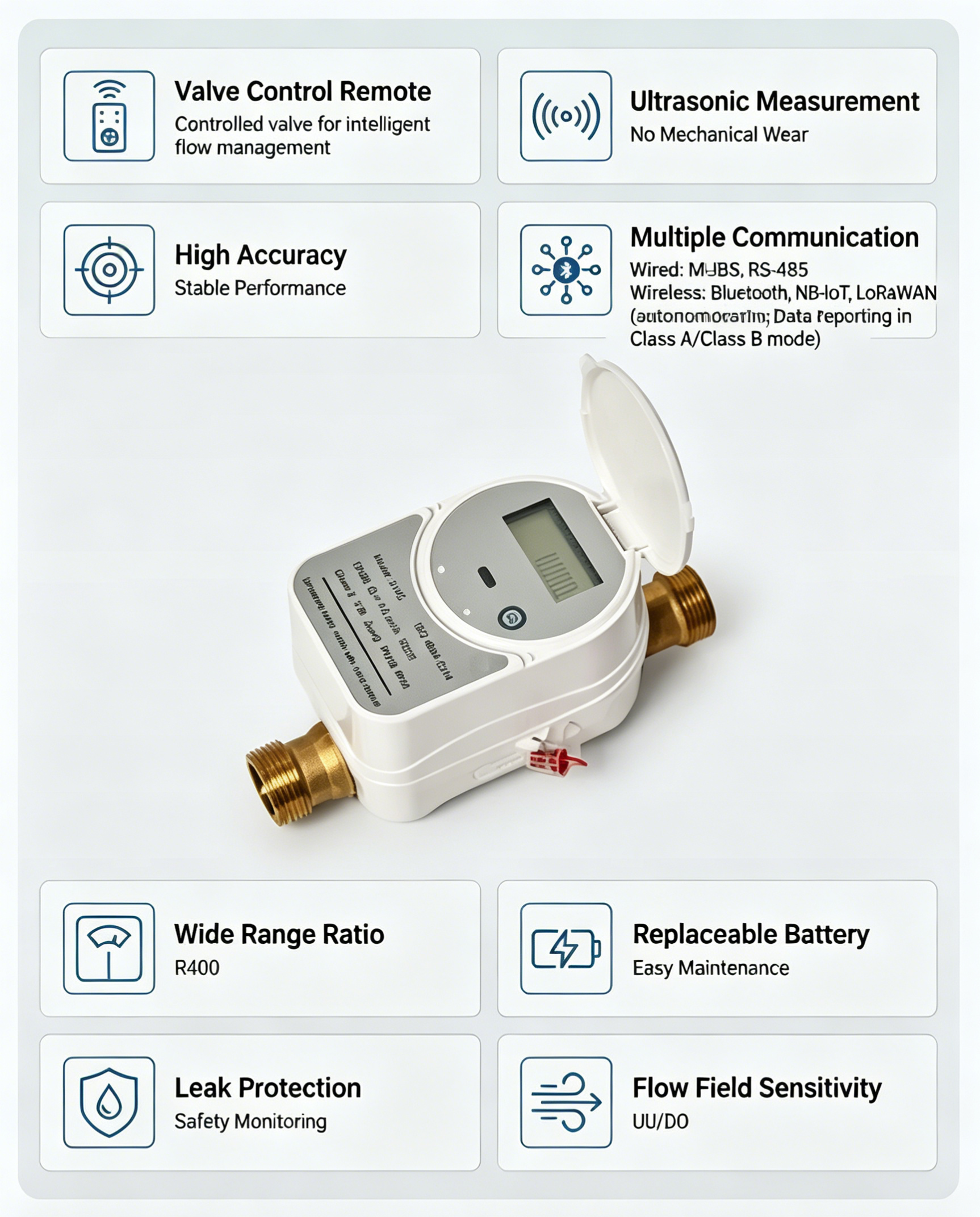
Typical Lifespan of an Ultrasonic Water Meter: Benchmarks and Real-World Data
Average service life: 12–15 years under optimal conditions
Under optimal conditions—stable pressure, low sediment, and correct straight-pipe runs—an ultrasonic water meter typically delivers 12–15 years of service before measurable accuracy drift exceeds utility tolerances. This benchmark reflects solid-state transit-time measurement with no moving parts, eliminating the mechanical wear that limits conventional meters. Field audits of smart metering fleets (2024) show well-installed units often remain within ±2% of original calibration for 15–20 years. The upper bound depends on power management, transducer stability, and water chemistry—not mechanical fatigue. Utilities following ISO 4064-2:2024 test protocols and avoiding air entrapment report fewer mid-life accuracy failures. Accelerated life testing supports this range: many electronic components are rated for 20-year service at 25°C ambient. Importantly, the 12–15 year window is not a fixed expiry—it’s a conservative planning assumption for replacement cycles. Many operators extend service beyond 15 years when annual verification confirms stable signal quality and sufficient battery reserve.
Comparison with mechanical meters: Why ultrasonic water meter longevity exceeds traditional alternatives
Mechanical water meters—single-jet, multi-jet, volumetric, or Woltman—commonly last 8–15 years in the field, but their accuracy often degrades within 5–8 years due to turbine, bearing, and gear wear under continuous flow. Ultrasonic meters avoid this failure mode entirely. Transit-time measurement relies on piezoelectric transducers and digital signal processing—not rotating parts—so calibration drift is substantially lower. Field comparisons show ultrasonic units maintaining metrological compliance for 15–20 years, about two to three times longer than mechanical meters before significant accuracy loss (2023). This longevity advantage reduces lifecycle cost: fewer replacements, less labor, and fewer billing disputes. For utilities, the extended stable metrology window makes ultrasonic meters a preferred choice for district metered areas and high-turnover service points.
Field validation: EU smart metering pilots show >90% functionality at year 12 (EN 1434-2015)
European smart metering pilots provide real-world validation. In multi-year deployments assessed against EN 1434-2015 metrology criteria, over 90% of ultrasonic water meters remained fully functional at year 12 (2023 field data). Early-life failures were concentrated in the first 24 months and traced to installation issues—air bubbles, misalignment, or insufficient straight pipe—not component wear. After this infant-mortality period, survival rates flattened, consistent with solid-state reliability. These results support using 12–15 years as a conservative planning figure, with many assets continuing beyond that window when battery reserve and signal quality are monitored. The pilot data also highlight the importance of commissioning checks to filter out installation defects before they skew long-term reliability metrics. Utilities can use this field data to schedule proactive replacement rather than reactive failure response.
Design Advantages: How No Moving Parts Extend Ultrasonic Water Meter Life
Ultrasonic water meters gain much of their long service life from a design that removes physical moving parts.
Elimination of mechanical wear—no turbines, bearings, or gears to degrade
Ultrasonic meters use non-contact measurement, so there are no turbines, bearings, or gears to wear down. Mechanical meters depend on moving parts that degrade from friction and mineral contact—causing accuracy to fall and failures to rise. A 2023 industrial reliability study found solid-state ultrasonic designs last 2–3 times longer than diaphragm or turbine-based meters in municipal applications. The absence of moving parts eliminates 87% of common failure modes associated with traditional meters. This design immunity to particulate contamination and mineral buildup reduces maintenance interventions by 60–75% compared with mechanical systems. While mechanical meters require recalibration every 5–7 years due to internal wear, ultrasonic meters maintain functionality beyond 15 years in typical installations. Because the core measurement channel has no contact with internal components, the meter avoids many wear-related breakdowns entirely—reducing service visits and extending replacement intervals.
Stable accuracy over time: minimal drift due to solid-state signal processing
Ultrasonic measurement uses solid-state electronics—not physical movement—to determine flow. With no gears or pistons to wear, accuracy drift remains small over years. Research from the International Water Association indicates non-mechanical meters stay within ~1.5% accuracy for 15 years or more—roughly three times longer than older diaphragm meters in similar conditions. Traditional meters often show output errors increasing up to 4% annually as internal parts erode. Ultrasonic meters measure the transit time of sound waves, so repeated use does not degrade precision. The solid-state design avoids corrosion, mineral deposits, and particle blockages that commonly affect moving parts. This stability reduces recalibration needs and keeps billing and leakage data reliable—helping utilities avoid revenue loss from under-registration and lowering field verification frequency.
Power and Electronics: Battery Life and Component Reliability in Smart Ultrasonic Water Meters
Long-life lithium cells (ER26500/ER34615) enabling 8–15+ years with optimized wake cycles
Battery architecture is the central determinant of an ultrasonic water meter’s field life. Long-life lithium thionyl chloride cells—commonly the ER26500 and larger ER34615—are preferred because they deliver high energy density, low self-discharge, and stable voltage across a wide temperature range. With optimized wake cycles, the meter spends most of its time in a microamp sleep state and wakes only for flow sampling or scheduled data transmission. A standard ER26500 cell typically supports 8 to 12 years of operation at 15-minute measurement intervals, while ER34615 configurations can exceed 15 years when paired with NB-IoT or LoRaWAN duty cycles that limit daily transmissions. Component reliability mirrors this design: solid-state ultrasonic transducers and low-power application-specific integrated circuits avoid electromechanical wear, so battery depletion—not sensor failure—remains the primary replacement trigger for a smart ultrasonic water meter.
Key Threats to Ultrasonic Water Meter Longevity: Misapplication and Environmental Stressors
Installation errors: improper orientation, upstream turbulence, and air entrapment degrading signal integrity
Improper installation can silently shorten the life of an ultrasonic water meter. The meter requires a stable flow profile to measure transit time correctly. Best practice calls for 10 pipe diameters of straight run upstream and 5 diameters downstream. Mounting too close to elbows or valves introduces turbulent swirl that distorts the acoustic path—field tests show up to 14% measurement errors in such conditions (2022). Air entrapment is another common issue: when transducers face downward or air collects in the pipe, bubbles scatter or block ultrasonic signals. Though the meter’s signal processor compensates, prolonged exposure increases drift and reduces long-term reliability. Installers should mount the meter horizontally with sensors facing upward and secure the pipe to limit vibration.
Environmental impact: E1/E2 ratings, thermal stress on piezoelectric transducers, and water quality effects (scaling, sediment, chlorine)
Environmental class ratings such as E1 and E2 define humidity, temperature, and electromagnetic conditions a meter can tolerate. A mismatch between the rated class and the actual site exposes internal electronics to condensation or interference—and shortens service life. Thermal stress on piezoelectric transducers is another threat: large temperature swings change acoustic impedance and can crack transducer bonding after repeated cycles. Water quality also matters. Hard water scaling coats the transducer face and pipe wall, reducing signal strength. Sediment can settle in low-flow sections and block the acoustic path—even though the meter has no moving parts. Chlorine and other oxidants may attack seals and plastic components, especially in poorly rated housings. Choosing the correct environmental class and monitoring water chemistry helps protect long-term performance. In coastal field tests, 92% of units maintained accuracy after five years of salt spray exposure (2023), but condensation and chemical attack remain leading causes of early failure.
Frequently Asked Questions
How long does an ultrasonic water meter typically last?
Under optimal conditions, ultrasonic water meters usually last 12–15 years while maintaining accuracy. Many units can exceed this lifespan, reaching up to 20 years with proper maintenance and favorable conditions.
Why do ultrasonic water meters last longer than mechanical meters?
Ultrasonic water meters have no moving parts, eliminating wear and tear. Unlike mechanical meters, which degrade due to turbine, bearing, and gear wear, ultrasonic meters rely on solid-state electronics and digital signal processing, which are more durable and yield better long-term accuracy.
What factors can negatively affect the lifespan of an ultrasonic water meter?
Poor installation practices, environmental stressors, and water quality issues like scaling, sediment, and chemical exposure can reduce the lifespan of an ultrasonic water meter. Proper orientation, stable environmental conditions, and regular monitoring can prevent such issues.
Is it necessary to replace an ultrasonic water meter every 15 years?
Fifteen years is a conservative benchmark for planning replacement cycles, but many ultrasonic meters function effectively beyond this period. Regular verification of signal quality and battery health can help determine when replacement is necessary.
What kind of batteries do ultrasonic water meters use, and how long do they last?
Ultrasonic water meters commonly use lithium thionyl chloride batteries (e.g., ER26500 or ER34615), which can last 8–15 years depending on power management and usage patterns.
Table of Contents
- Typical Lifespan of an Ultrasonic Water Meter: Benchmarks and Real-World Data
- Design Advantages: How No Moving Parts Extend Ultrasonic Water Meter Life
- Power and Electronics: Battery Life and Component Reliability in Smart Ultrasonic Water Meters
- Key Threats to Ultrasonic Water Meter Longevity: Misapplication and Environmental Stressors
-
Frequently Asked Questions
- How long does an ultrasonic water meter typically last?
- Why do ultrasonic water meters last longer than mechanical meters?
- What factors can negatively affect the lifespan of an ultrasonic water meter?
- Is it necessary to replace an ultrasonic water meter every 15 years?
- What kind of batteries do ultrasonic water meters use, and how long do they last?