
 EN
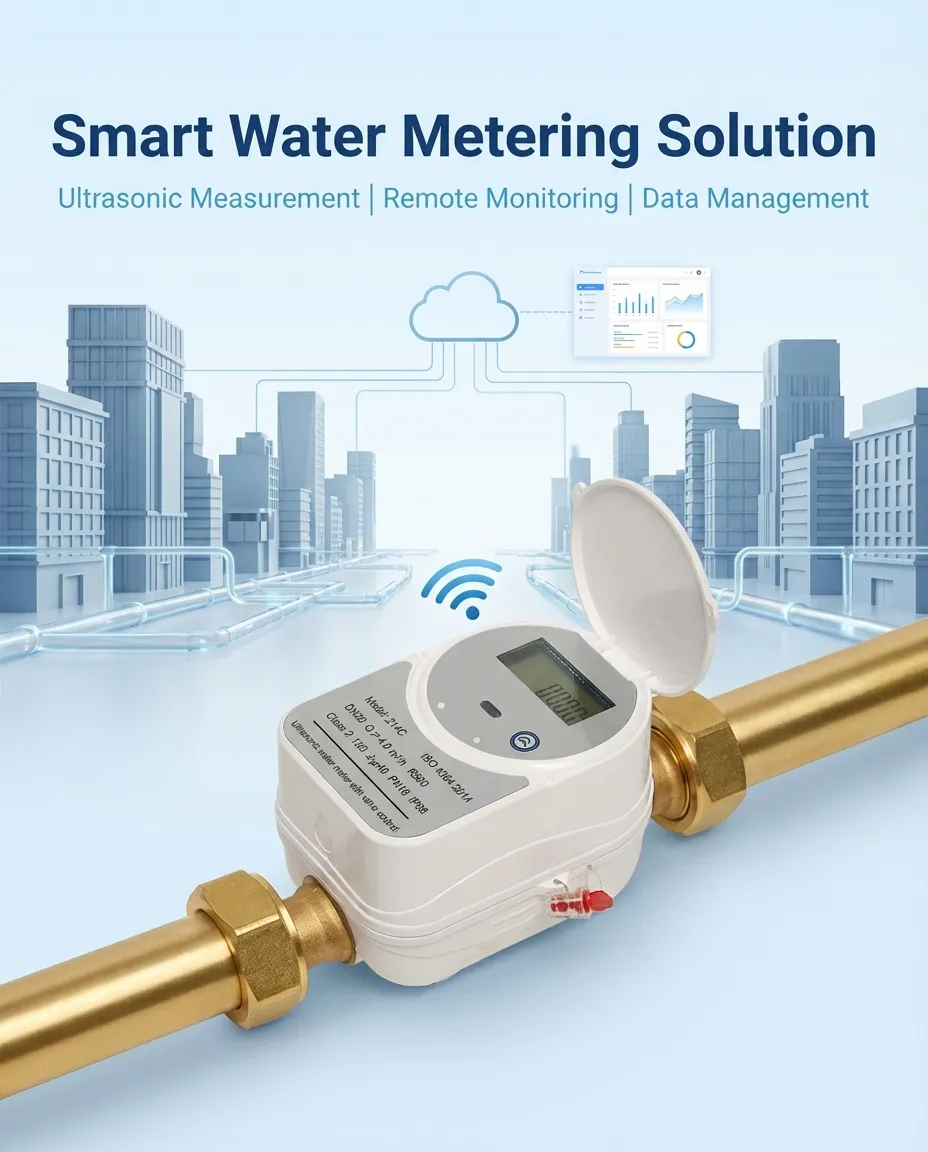
Superior Accuracy and Long-Term Reliability
How mechanical meter drift undermines billing integrity over time
Mechanical water meters rely on moving parts—impellers, pistons, or oscillating discs—that gradually wear under continuous flow, sediment, and pressure fluctuations. As bearings erode and chambers score, calibration shifts: many units under-register low flows, while others over-register at high velocities. Field data indicate displacement meters can drift by 10–15% after five years of service (AWWA, Water Meter Performance Standards, 2023). This drift triggers no alarms, so utilities continue billing on inaccurate volumes. Under-registration quietly erodes revenue; over-registration invites customer disputes and regulatory penalties. Without frequent bench testing—a costly and logistically complex process—billing integrity becomes probabilistic rather than assured. Ultrasonic water meters eliminate the root cause of drift, preserving measurement trust and stabilizing revenue across their full service life.
Ultrasonic water meter precision: ±0.5% accuracy across full flow range without recalibration
Ultrasonic water meters measure velocity by timing acoustic signals traveling upstream and downstream through the flow tube. With no rotating or reciprocating parts, there is nothing to wear, jam, or slow with sediment. The transit-time principle delivers consistent performance from trickle flows near 0.5 L/h up to maximum rated flow, holding accuracy within ±0.5% across the full range—certified to ISO 4064 Class 1 (2024). Because transducer stability and digital signal processing remain unchanged over time, recalibration is not required during a typical 10–15 year service life. This eliminates recurring bench-testing costs, field service visits, and the risk of undetected calibration drift. Utilities gain revenue-grade reads without seasonal recalibration campaigns—streamlining operations and improving long-term billing predictability.
Field validation: a major water utility’s 5-year trial—98.7% sustained accuracy vs. 72% for displacement meters
A five-year field validation conducted by a major UK water utility confirmed that ultrasonic water meters sustained 98.7% billing accuracy across diverse residential and commercial conditions—including hard water, sediment, and variable demand—while displacement meters in the same network fell to 72% average accuracy over the same period. The 98.7% result reflects near-perfect alignment between billed and trued-up volume, significantly reducing revenue loss and customer complaints. In contrast, the 72% displacement-meter accuracy indicates chronic under-registration, forcing the utility to recover lost revenue through rate adjustments or write-offs. This real-world evidence confirms that long-term ultrasonic performance directly safeguards billing integrity and supports equitable, transparent cost recovery.
Lower Total Cost of Ownership Through Zero Moving Parts
Mechanical failure drivers: sediment, corrosion, and wear in real-world networks
Mechanical water meters depend on rotating impellers, pistons, and gear trains continuously exposed to flowing water. In real distribution networks, suspended sediment, sand, rust particles, and biofilm enter the measuring chamber. These abrasive materials accelerate bearing wear and degrade measurement fidelity. Corrosion from aggressive water chemistry attacks metal components, increasing friction and causing binding. Water hammer and pressure transients add mechanical stress, hastening fatigue and failure. Each failure demands reactive maintenance—triggering truck rolls, service delays, and billing disputes. Over time, these escalating operational costs shift financial burden from initial purchase price to ongoing expense, undermining the total cost of ownership (TCO) advantage of mechanical meters.
Solid-state ultrasonic water meter design eliminates maintenance-critical components
Ultrasonic water meters replace mechanical components with solid-state transducers that measure transit-time differences in the flow path. With no moving parts exposed to sediment or corrosion, wear-related accuracy drift is effectively eliminated. Metrological stability remains intact over the asset’s lifetime—no periodic recalibration of mechanical assemblies is needed. Maintenance is typically limited to long-life battery replacement. Utilities avoid routine cleanings, gear replacements, and unplanned field repairs. Lower failure rates reduce emergency callouts and extend service life. Even with a higher upfront cost, the TCO falls meaningfully over 10–15 years—shifting operations from reactive fixes to predictable, budget-friendly service planning.
Real-Time Leak Detection and Non-Revenue Water Reduction
Ultrasonic-enabled sub-liter-per-hour monitoring for early anomaly detection
Ultrasonic water meters continuously record flow at sub-liter-per-hour resolution—capturing subtle usage changes that mechanical meters miss due to static friction and wear-induced dead bands. With no moving parts, low-flow sensitivity remains stable over time, enabling reliable baseline establishment. Utilities analyzing sub-hourly readings can identify persistent low-flow signatures—such as a slow service line seep or a stuck irrigation valve—before they escalate into visible breaks. High-resolution temporal data also helps localize leaks within ~15 m, narrowing repair efforts from broad search zones to targeted interventions. Early detection reduces average repair time from days to hours, lowers labor and infrastructure damage costs, and minimizes water loss before it impacts customers or system integrity.
Proven NRW reduction: 15–25% drop in pilot utilities using ultrasonic water meters
Pilot deployments consistently demonstrate meaningful non-revenue water (NRW) reduction following adoption of ultrasonic water meters. According to the American Water Works Association (AWWA, Non-Revenue Water Management Guide, 2023), validated field programs document NRW reductions of 15–25%. Larger gains occur when ultrasonic data is integrated with pressure monitoring and hydraulic modeling. Because ultrasonic meters sample flow dozens of times per second, they capture intermittent or pulsating leaks that mechanical registers would smooth out or ignore entirely. These improvements stem from faster leak identification, fewer large hidden breaks, and more accurate low-flow billing—transforming every service connection into a continuous, intelligent monitoring point.
AI-enhanced pulse analysis: detecting micro-leaks <0.05 L/min with 91% precision
AI-enhanced pulse analysis leverages the high-frequency data stream from ultrasonic water meters to detect anomalies invisible to conventional methods. Machine learning models trained on millions of real-world pulse signatures distinguish normal nighttime use patterns from micro-leak behavior—even below 0.05 L/min. As reported in AWWA’s 2023 field validation study, these models achieve 91% precision in micro-leak detection, drastically cutting false positives common in pressure-based systems. Utilities can now prioritize the smallest leaks before they grow—reducing repair costs, protecting pipe integrity, and maintaining water quality. The combination of native sub-liter resolution and AI classification gives operators actionable confidence—not just alerts—enabling a strategic shift from reactive repair to preventive, data-driven network management.
Native Compatibility with AMI and Smart Water Infrastructure
Advanced Metering Infrastructure (AMI) is the integrated system smart water meters use to collect, manage, and analyze consumption data. It comprises smart meters, communication networks, data management software, customer portals, remote monitoring tools, security protocols, and billing integrations. Ultrasonic water meters align natively with this architecture: they generate high-resolution, time-stamped digital flow data ready for secure transmission—no encoder registers or analog-to-digital conversion layers required.
AMI delivers maximum value when connected to broader digital water systems. Typical integrations include:
- Geographic information systems (GIS)
- SCADA platforms
- Digital twin models
- IoT pressure sensors
- Hydraulic simulation software
- Asset management systems
- AI-based predictive analytics
Together, these tools form a responsive, networked water grid that monitors asset condition, hydraulic performance, and demand patterns in real time. By correlating pressure fluctuations, flow anomalies, and consumption irregularities, utilities can locate leaks faster and validate system-wide performance. Because ultrasonic meters deliver continuous, granular data streams, they support automated billing, dynamic tariff applications, conservation analytics, and proactive infrastructure planning—reducing deployment friction for utilities modernizing aging networks. The result is a resilient, intelligent water infrastructure that strengthens billing accuracy, advances sustainability goals, and enhances operational visibility.
FAQ Section
Why do mechanical water meters experience drift over time?
Mechanical water meters drift due to wear on moving parts such as impellers or pistons caused by sediment, pressure fluctuations, and continuous flow. This results in inaccurate measurements over time.
What is the accuracy of ultrasonic water meters?
Ultrasonic water meters maintain accuracy within ±0.5% across their full flow range and do not require recalibration during their 10–15 year service life.
How do ultrasonic water meters help in detecting leaks?
Ultrasonic water meters offer sub-liter-per-hour resolution and continuous monitoring, enabling the detection of anomalies like leaks or seepages before they escalate into significant problems.
How do ultrasonic water meters reduce non-revenue water?
Ultrasonic water meters reduce NRW by analyzing flow data patterns, capturing intermittent or pulsating leaks, and enabling faster identification and targeted repair actions.
Are ultrasonic water meters compatible with smart water systems?
Yes, ultrasonic water meters are natively compatible with Advanced Metering Infrastructure (AMI) and can integrate seamlessly with digital water systems and smart infrastructure tools.